


How Smart Execution Strengthens Crypto Trading
 6 minutes

Smaller crypto trading firms often struggle to maximise performance when confined to a single exchange or limited venues. In crypto’s fragmented market, liquidity is spread across hundreds of exchanges, leading to price discrepancies and higher trading costs for those without multi-venue execution. This post explores the extent of crypto market fragmentation, how it inflates execution costs (slippage, spreads and missed opportunities), and why teams using smart order routing or an Execution Management System (EMS) consistently outperform those who don’t. We’ll dive into data on venue fragmentation and trade performance, and conclude with insight-driven suggestions for leveraging smart execution.
Fragmented Crypto Markets: Many Venues, Dispersed Volume
Crypto trading is highly fragmented across a large number of exchanges. According to recent data, there are over 1,600 cryptocurrency exchanges worldwide (although only a few hundred have meaningful volume). Unlike traditional equities, where a few centralised venues dominate, crypto’s trading volume is split among many players. Just 5–10 major exchanges handle the bulk of volume, but no single venue holds a majority share. For instance, the top 10 exchanges by volume make up only about half of total market activity, with the remainder scattered across hundreds of smaller venues. This dispersion of liquidity means that the best available price for a given trade might be split among multiple exchanges at any time.
Fragmentation isn’t just about the count of venues; it also has a latency dimension. Each exchange operates independently, with different servers and locations, so price information travels at finite speed between venues. This can lead to short-lived price discrepancies (“latency arbitrage” opportunities) where one exchange’s price lags behind another’s during fast markets. In other words, without a unified order book, crypto has many best prices at once, and they don’t instantly equalise. Traders stuck on a single venue may get a worse price simply because another venue had a better quote a few milliseconds earlier. Over many trades, these small differences add up.
Execution Costs: Slippage and Missed Opportunities
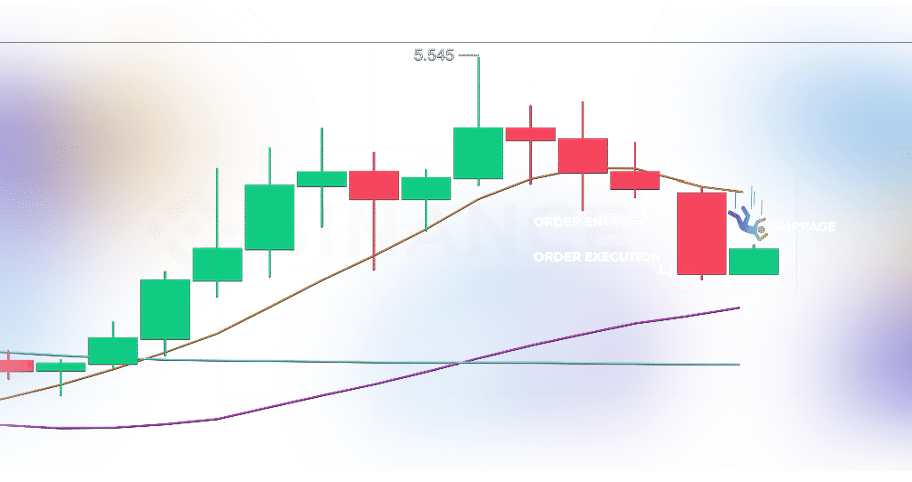
Fragmentation directly impacts execution costs for trading teams. When liquidity is spread thin, trading on only one venue often means higher slippage and wider spreads. During normal conditions, slippage might seem minor, but even small per-trade costs can accumulate significantly.
One study calculated that a mere 0.073% price deviation on each trade (due to order book limitations) would compound to a 26.65% drag on performance over a year of daily trading. This illustrates how fragmentation-related costs quietly erode profits.
In volatile or fast markets, the impact is even more pronounced. Less liquid exchanges experience outsized slippage and spread blowouts during significant price movements. For example, on August 5, 2024, amid a sharp crypto sell-off, Bitcoin prices on a smaller exchange diverged significantly from more liquid markets. Other stablecoin-based markets (usually among the deepest) still saw slippage jumps of over 3 basis points during that stress event. The lack of depth on smaller platforms meant trades there incurred far higher costs for the same order. Likewise, bid-ask spreads tend to be wider on lower-volume exchanges, effectively charging traders a higher “entry/exit fee” on each trade.
A team trading only on one mid-tier exchange might routinely pay a spread several times larger than what’s available on a top-tier venue or aggregated across venues. Beyond immediate costs, opportunity cost is a quieter killer. In a fragmented market, the optimal price or larger sizing for your trade could be sitting on another exchange you’re not connected to. Traders operating on a single venue must either accept the local price (which could be suboptimal) or forego the trade.
As an example, if Exchange A has a limit sell order at a better price than anything on Exchange B’s order book, a team trading only on B misses the chance to trade at that superior price. Similarly, if your primary exchange goes down for maintenance or suffers an outage during a crucial market moment, you’re sidelined, whereas a multi-venue approach provides alternatives to continue executing. In short, fragmentation forces hard choices: either tolerate subpar pricing from limited liquidity pools or invest extra effort (and fees) to manually bridge across venues. Both options weigh on performance.
Data confirms that fragmentation-driven inefficiencies hurt smaller traders. Without multi-venue execution, transaction costs are consistently higher. Traders face higher slippage and price impact because any single venue often lacks enough depth for larger orders. They may also incur more volatile fills, as fragmented markets exhibit more frequent price jumps and divergences. All these factors mean that a small firm sticking to one exchange is likely leaving money on the table through avoidable execution losses.
Smart Execution vs. Single-Venue: Performance Gap
If fragmentation is the problem, smart execution across multiple venues is the solution. Firms that use an Execution Management System (EMS) or smart order routing can tap into aggregate liquidity and dynamically seek the best prices available. This isn’t just theoretical; the performance difference is backed by analytics. One analysis found that a $1 million Bitcoin market order would incur an additional 4 – 13 basis points of slippage if executed on a single exchange, compared to being smart-routed across four exchanges (median case). For a larger $5 million BTC order, the single-venue slippage penalty jumped to about 134 bps (1.34%) in the median scenario. The gap can be even more extreme for illiquid assets: in the study, certain altcoin orders showed slippage over 7,000 bps (70% price impact!) on one exchange, which a multi-venue strategy could vastly reduce. Smart execution materially improves prices and reduces hidden costs.
Larger orders and illiquid assets see exponentially higher costs on a single exchange. Even a $1M BTC trade can save on the order of 5 – 10 bps via multi-venue execution, while a $5M trade might save over 1% in price slippage.
Beyond slippage, there are qualitative performance benefits that give teams an edge when leveraging multi-venue execution. These include:
- Access to deeper liquidity: By connecting to multiple exchanges, traders can draw from a larger combined order book. This makes it more likely to fill large orders quickly without moving the market. In practice, an EMS can sweep the top of the book from several venues at once, achieving a fill that no single exchange could offer alone.
- Better pricing: With smart order routing, a trade can be split and sent to whichever venue is offering the best price at that moment. Traders effectively comparison-shop in real time across exchanges for optimal rates. This results in lower spread costs and better execution prices, directly boosting the profitability of a strategy.
- Reduced market impact & slippage: Splitting an order across venues also mitigates the impact on any single order book. A large order dropped on one exchange can sweep the book and cause a sharp price move against the trader; instead, slicing it into smaller chunks across multiple venues hides its true size. The result is less information leakage, other market participants are less likely to notice and front-run or push prices adversely, and the overall slippage is minimised.
- Lower risk of outages or bottlenecks: Relying on a single platform introduces a single point of failure. If that exchange has a downtime or technical issue, your trading halts. Multi-venue connectivity provides redundancy: if one venue falters, others can pick up the slack. This resilience is crucial for small teams, as it protects against missed opportunities during critical market windows (e.g. a sudden rally or crash) due to one venue’s problems.
In contrast, single-venue execution simplifies operations but at a steep cost. Some teams stick to one exchange for convenience, fewer connections and accounts to manage, maybe even volume discount fees with that venue. However, as shown above, any such savings are often dwarfed by the performance losses in price and slippage. The crypto market’s complexity today rewards those who can navigate fragmentation effectively. Even many institutional traders have shifted to multi-venue setups to ensure they aren’t “blind” to better prices elsewhere. For an agile small trading firm, adopting smart execution tools can level the playing field with larger players who already aggregate liquidity.
Gaining an Edge with Smart Execution
It’s evident that smart execution across venues gives a measurable edge in crypto trading. By addressing the fragmentation of liquidity, small trading teams can reduce slippage, tighten spreads, and capture opportunities that single-exchange traders miss. The tone of this insight is not meant to hype any product, but the data speaks for itself: an EMS or smart order router can turn fragmentation from a hindrance into an advantage. Not only does it cut costs, it also frees up traders from manual legwork (constantly checking multiple platforms) and lets algorithms do the heavy lifting of finding the best prices.
In a market as fast-moving and distributed as crypto, efficient execution is as important as good strategy. A trading idea that should be profitable can be undermined by poor execution, paying 0.2% extra here, missing a trade there, and getting slipped in volatile moments. Smart execution ensures you capture more of the alpha you generate on paper. It’s a bit like having a high-performance engine in a race car: you may be a skilled driver (trader), but without that engine (execution infrastructure), you won’t reach top speed.
For small and mid-sized crypto trading firms, the takeaway is to consider upgrading your execution capabilities. This doesn’t mean you need a Wall Street-level tech stack overnight. Many third-party solutions and service providers offer execution management systems tailored to crypto, which can connect your trading to multiple exchanges through one interface. Adopting such tools can help overcome the challenges discussed: fragmented liquidity, slippage and operational risk, in a cost-effective way. It’s a strategic investment into your trading workflow that can pay back through better P&L outcomes.
Finally, while this post isn’t a sales pitch, it is a call to action of sorts: Don’t let fragmentation be a thorn in your side. Insight-driven execution is within reach even for smaller teams. Whether through building in-house or partnering with technology providers, gaining smart-routing capability can empower your firm to trade smarter and more competitively. In an industry where every basis point and millisecond counts, smart execution is not just a luxury for the big players; it’s an edge that small crypto trading teams should actively seek out. If you’re operating without multi-venue execution today, take a hard look at the data and consider reaching out to experts or providers in this space to explore how you can upgrade your approach. It could very well be the catalyst that elevates your trading performance to the next level.
Further Reading
- X Liu, Market Fragmentation in Cryptocurrency Exchange, SSRN, 2023
Market Fragmentation in Cryptocurrency Exchange - Maximizing Opportunities with Multi-Venue Liquidity, Talos Insights (Sept 2023)
Unleash the Potential of Multi-Venue Liquidity - How is crypto liquidity fragmentation impacting markets? Kaiko Research (Aug 2024)
How is crypto liquidity fragmentation impacting markets? - A dive into liquidity demographics for crypto asset trading, S&P Global (May 2025).
A dive into liquidity demographics for crypto asset trading - Fragmented Crypto Data: Risks, Tools, and Solutions, CryptoWorth Blog (2025).
Fragmented Crypto Data - The great crypto liquidity fragmentation problem, e‑Forex (July 2025).
The great crypto liquidity fragmentation problem - O. Kuznetsov et al., “Machine Learning Analytics for Blockchain-Based Financial Markets: A Confidence-Threshold Framework for Cryptocurrency Price Direction Prediction,” Applied Sciences (2025).
Machine Learning Analytics for Blockchain-Based Financial Markets







































































































Contact Us
We are always open to discussing new ideas. Do reach out if you are an exchange or a project looking for liquidity; an algorithmic trader or a software developer looking to improve the markets with us or just have a great idea you can’t wait to share with us!